
Starting From Zero: Beginner-Friendly Fitness in Denver (2026)
Every fitness list in this city is written for people who already know what the words mean. Two revealing local threads came from adults who'd been…
Every fitness list in this city is written for people who already know what the words mean. Two revealing local threads came from adults who'd been trying for years — one wanted a yoga teacher who would physically correct her positioning after decades of never getting it, another wanted a hot class where you hold poses instead of flowing and couldn't find one. Neither was a beginner problem. Both were vocabulary problems, and vocabulary is fixable in five minutes.
Why does every class schedule assume you already know the words?
Because studios write schedules for their existing members. Here's the translation, and it's more useful than any list of studios.
Vinyasa, flow and power mean the same underlying thing: movement paired with breath, where the transitions between poses matter more than the poses. It descends from Ashtanga. Expect to move continuously and to hear pose names without much explanation.
Hatha on a Western schedule usually signals the slower one, where poses are set up and held individually instead of linked into a sequence. It isn't a standardized term, though, so it's worth one email to confirm what a studio means by it.
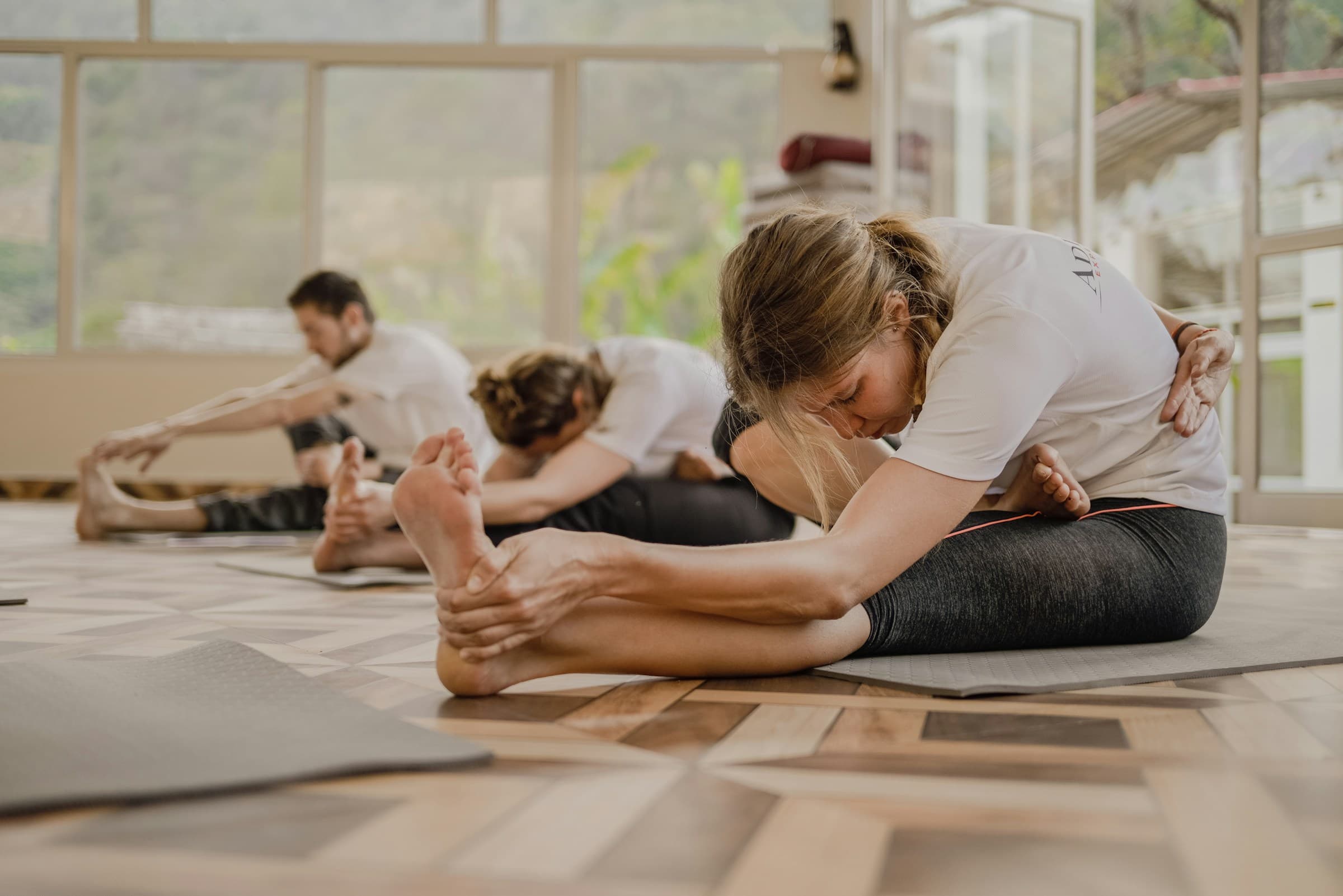
Yin is passive floor work. Poses are held around five minutes each, sometimes longer, with very little muscular effort, and the target is connective tissue — tendons, fascia, ligaments — mostly in the hips, pelvis and lower spine. Rooms are kept warm because you generate no heat yourself.
Restorative looks similar and does the opposite. Your body is fully propped on bolsters, blankets and blocks so it can stop working entirely; poses are sometimes held twenty minutes, and a class might contain four to six of them. It's built for people carrying injury, illness or stress, in smaller classes with more individual attention. Yin asks the tissue to load; restorative asks it to do nothing. Being sent to the wrong one is a common reason people decide yoga isn't for them.
Is there hot yoga where you hold poses instead of flowing?
Yes, and the reason it's hard to find is that it got renamed. The class is a fixed sequence of 26 postures — 24 poses plus two breathing exercises — over 90 minutes in a room at 105°F and 40% humidity. Every posture is set up, held and released individually. Nothing flows.
That sequence was branded under its founder's name for decades. After a 2019 documentary and civil judgments against him — including a multi-million-dollar jury award to a former employee — many studios stripped his name from their signage and relabeled the class simply as hot yoga.
So the sequence is still widely taught. It's just listed as 26&2, Hot 26, Original Hot Yoga, or "the 26 postures." Search those terms, not the founder's name.
What does "all levels" actually mean?
In practice it means the teacher will offer modifications, not that the class moves slowly. It's the default label most studios put on most classes, which makes it close to meaningless as a filter.
What you want is a class called fundamentals, foundations, basics, intro, or something with 101 in the name — ideally a multi-week series rather than a drop-in. The series format is the one that teaches, because the teacher sees the same bodies twice and can build on last week. It also solves the social problem: everybody there is equally lost, on purpose.
How do you find a teacher who will actually correct your form?
Ask before you book. One email: do your teachers give hands-on adjustments, and can I opt into them? Studios answer readily, and the answer tells you a lot.
Worth knowing why you have to ask: many studios moved to a consent system — a card or chip on your mat, or a show of hands at the start — so nobody is touched without opting in. That's a good change, and it means the default is now no correction unless you ask. That's exactly the gap the person with 25 years of frustration kept falling into. Nobody was refusing to help her. She was being quietly opted out.
Class size is the strongest predictor after that. A teacher with ten people can watch you; one with forty cannot. A private session or two before joining group classes is the highest-value money a nervous beginner can spend. And say something when you arrive — "first class, bad left knee" gets you specific attention for an hour.
Why is the cardio so much harder than it should be?
If you're new to Denver and your fitness feels like it collapsed, the altitude is doing some of that. Your sea-level pace isn't your pace here, at least not yet, and the first weeks are the worst of it. Stop using pace as your gauge and use effort instead — if you can't speak in full sentences, you're working hard enough. Our altitude guide covers the rest.
Run clubs are the strongest beginner cardio option here, and most have a walk or slow group whether or not the flyer says so. Our run club guide exists in the format it does because the nationally-ranked roundups list twenty-plus Denver clubs with almost no meeting times, locations or signup links — useless to the person who needs to know which corner to stand on, and when.
How do you check a studio's beginner claim before paying?
Three questions by email, and the tone of the reply matters as much as the content. What's the cap on class size. Do you run a fundamentals or intro series, not just all-levels classes. Do teachers offer hands-on adjustments.
Then the logistics nobody tells you: arrive fifteen minutes early for the waiver, mats are almost always rentable, wear whatever you can bend in. A discounted multi-week intro block beats a single free class, because one class tells you nothing. And you're allowed to sit down mid-class, skip a pose, or leave. Nobody's watching. They're all managing their own balance.
Practical Notes
- "All levels" means modifications are offered, not that the class is slow — look for fundamentals, foundations, basics or 101.
- Yin holds about five minutes and loads connective tissue; restorative props you up and asks nothing of you.
- For held poses in a hot room, search 26&2, Hot 26 or Original Hot Yoga.
- Ask about hands-on adjustments in advance; many studios now require you to opt in.
- One or two private sessions before group classes is the best money a nervous beginner can spend.
If you're starting exercise after a long gap, check with a doctor first when you have a heart condition, chest pain, unexplained dizziness or shortness of breath, or you're pregnant. Being new to this isn't a medical problem. Those are.
See More
Free download
New to Denver? Skip the trial and error.
The New-to-Denver Starter Kit, free the second you join: where to live, how to find your people, and what to do first. Plus the Food & Drink Field Guide and the Weekend Playbook. One short email a week.
Free. 3-minute read. Unsubscribe in one click.