

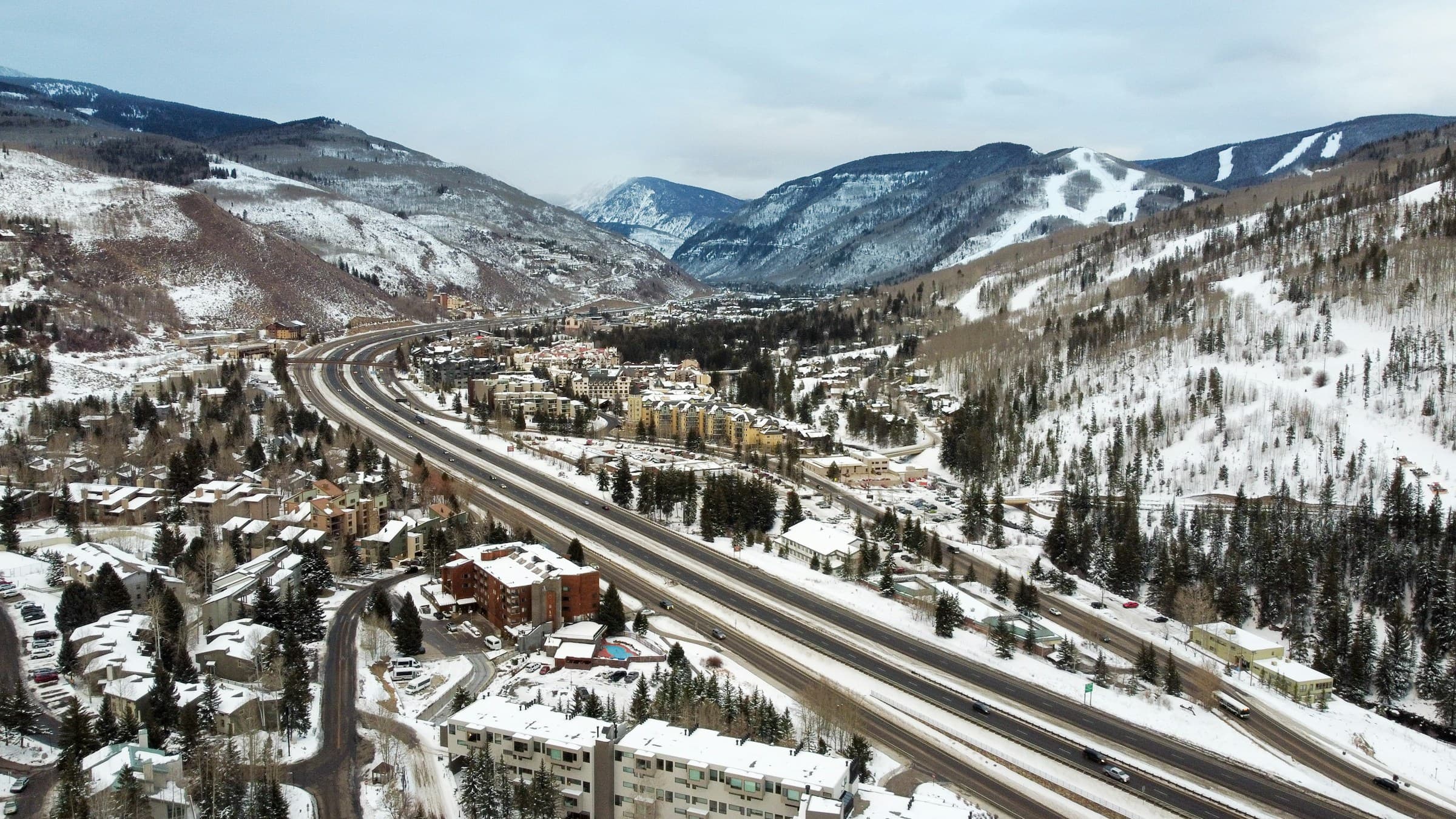
I-70 to the Mountains (2026–27): When to Leave, and When to Give Up
Every winter somebody asks how early they need to leave Denver to make first chair, and every winter they get forty different answers. The honest…
Every winter somebody asks how early they need to leave Denver to make first chair, and every winter they get forty different answers. The honest version has two parts: a departure time that mostly works, and a shorter list of days where no departure time works and the right move is to not go. Both are below.
What time do I actually have to leave on a Saturday?
Earlier than the drive time suggests. Denver to Summit County is roughly ninety minutes with no traffic, which is the number that gets people in trouble, because the weekend westbound rush isn't spread evenly — it stacks.
CDOT's guidance is to plan departures "for mid-week or during the early morning hours." In practice, that means being past Idaho Springs before the wave arrives, not leaving Denver at a nice-sounding hour. A 6 a.m. departure from central Denver is comfortable on a normal Saturday. A 7 a.m. departure is a coin flip. An 8 a.m. departure on a powder Saturday in February means you are the traffic.
Friday afternoons deserve their own warning. CDOT identifies 2–7 p.m. Friday as the worst westbound window — that's commuter volume and weekend volume occupying the same road. If you're going up Friday, either leave before lunch or leave after 8 p.m.
Why is Sunday worse than Saturday?
Because Saturday morning traffic is spread across four or five hours of individual decisions, and Sunday afternoon traffic is one decision that forty thousand people make at the same time: check out, ski till two, drive home.
CDOT puts the worst eastbound window at Sunday evenings, 3–6 p.m., and notes that traffic "starts to build as early as 11:30 a.m." That 11:30 detail is the useful one, and it's the part most people get wrong. There is no clever mid-afternoon gap. If you are not eastbound through the Eisenhower Tunnel by roughly noon, your realistic options are to leave much later or to have dinner in Frisco and wait it out.
CDOT recommends exactly that: stay in the mountains for dinner, or stay Sunday night and drive back Monday morning. It sounds like a dodge. It is genuinely the best-performing strategy anyone has, and locals who ski a lot build their weekends around it.
What are the worst weekends of the year?
CDOT states the heaviest volumes come "around the holidays, school breaks, and on weekends in January and February." That maps to what regulars will tell you: the stretch from Christmas through Presidents Day is the hard season, and MLK weekend and Presidents Day weekend are the two reliably worst.
Add one variable CDOT doesn't publish — a big overnight storm turns an ordinary Saturday into a bad one, both because more people go and because the road itself slows down. A 12-inch report and a Saturday are the two ingredients you want to avoid combining.
Do the express lanes help, and are they worth it?
Sometimes, and it depends how you're billed. The I-70 Mountain Express Lanes run between Idaho Springs and Empire — roughly 12 miles of managed lane in each direction, 24 miles total — and CDOT opens them "on holidays, weekends and during peak travel times." The eastbound lane is the one that matters most, because it targets the Sunday return.
Two things to know before you use them. First, they are toll only. They are not free for HOV vehicles — CDOT is explicit about this, and there's no carpool exemption, motorcycles included. Second, the price depends entirely on whether you have a transponder. CDOT's rate schedule sets ExpressToll rates at $6 to $9, and License Plate Toll rates — what you pay if you just drive through and get billed by mail — at $12 to $18. Same lane, double the price for not having an account.
Trucks, trailers, and oversized vehicles aren't permitted. And the lanes only cover 12 miles of a 70-mile problem, so treat the toll as buying you a bypass of one specific bottleneck, not a fast lane home.
Is Steamboat different from everywhere else?
It's a different road, which is the real point. Steamboat isn't reached by I-70 at all — you go up US 40 over Berthoud Pass and Rabbit Ears Pass — so the corridor congestion that defines a Summit County weekend simply isn't the same constraint. The tradeoff is that you've swapped a traffic problem for a weather-and-pass problem, and US 40 closes more readily than I-70 does.
You'll hear that Steamboat's peak days invert the usual I-70 pattern. That may be true, but it isn't something a public dataset supports, so treat it as folklore until it isn't.
When is a Saturday simply not worth driving?
When three things line up: a holiday weekend, a fresh storm, and a departure after about 7:30 a.m. At that point you're not deciding between a good day and a slower day, you're deciding between a good day and four hours in the car for maybe three hours of skiing. Skip it, ski Monday, or go somewhere else.
The other honest answer is that the day trip is the wrong unit. Most people who ski a lot in Colorado eventually stop doing Saturdays from Denver and switch to Friday nights up, Sunday nights back, or midweek entirely. It's not a discipline thing. The arithmetic just stops working.
If you'd rather skip the driving question altogether, the bus and train options are more usable than most people assume — that's covered in Getting to the Mountains Without a Car.
Practical Notes
- Worst westbound window is Friday 2–7 p.m.; worst eastbound is Sunday 3–6 p.m., building from 11:30 a.m. (CDOT).
- Aim to be past Idaho Springs before the wave, not to leave Denver at a tidy hour.
- Sunday's only reliable strategy is leaving before noon or staying for dinner.
- Get an ExpressToll transponder before you need it — license-plate billing roughly doubles the toll.
- January and February weekends plus holiday weekends are the hard season; midweek is a different road.
See More
Free download
3 free Denver guides. Yes, really.
The Food & Drink Field Guide, the Weekend Playbook, and the New-to-Denver Starter Kit, yours the second you sign up. Plus one email a week, unsubscribe anytime.
Free. 3-minute read. Unsubscribe in one click.